Emergency FoodChecklist
Emergency Food Storage Checklist: 30, 90, and 365-Day Supplies
A practical emergency food storage checklist for 30, 90, and 365-day supplies — with shopping lists, shelf life data, and ready-made kit options for every budget.
By Editorial Team6 min read
Affiliate Disclosure: This article contains affiliate links. We may earn a commission if you purchase through these links, at no extra cost to you. Our editorial recommendations are independent of these partnerships. Learn about our editorial standards.
Key Takeaways
- 1Start with a 30-day supply (56,000 calories per person) using a mix of freeze-dried meals and pantry staples
- 2ReadyWise 240 Serving Kit + bulk rice and beans provides the most cost-effective 90-day baseline
- 3Store everything below 75°F — heat is the #1 factor that degrades freeze-dried food shelf life
- 4Rotate canned goods annually and freeze-dried meals every 5-10 years for optimal quality

Introduction
If you've been grocery shopping lately, you already feel it. According to the USDA Economic Research Service's January 2026 report, food prices are projected to rise another 3% in 2026 — driven by tariff-related packaging cost inflation and widening import delays from ongoing supply chain disruptions.
Building a food storage supply isn't about stockpiling for catastrophe. It's practical household insurance — the same logic as keeping a spare tire or a backup generator. FEMA recommends that every family maintain at least a 72-hour emergency food supply, but most preparedness professionals consider two weeks a realistic baseline and 90 days the point of meaningful resilience.
This emergency food storage checklist covers all three tiers: 30, 90, and 365 days. For each level, you'll find a practical shopping list of pantry staples and ready-made kit options. Start with the tier that fits your budget and available space, then build from there.
Key Takeaways
- FEMA recommends a minimum 72-hour supply; most preparedness experts recommend building toward 30–90 days
- Plan for approximately 2,000 calories per person per day (USDA daily reference value)
- Store what you eat: rotate stock regularly and stick to familiar foods your family will actually use
- Freeze-dried and dehydrated foods offer 25–30 year shelf lives; commercially canned goods typically last 2–5 years
- Ready-made emergency food kits can anchor a storage plan and save significant time compared to building from scratch
How Much Food Does Your Family Actually Need?
Before filling your pantry, do a quick calculation. The USDA uses approximately 2,000 calories per day as its general dietary reference for adults — though active individuals, teenagers, and larger adults may need more. For household planning purposes, 2,000 calories per person per day is a reliable working figure.
For a family of four over 30 days, that's roughly 240,000 calories total. Broken down by food category, it becomes manageable. Calorie-dense pantry staples are the foundation of any food storage plan: white rice yields approximately 1,700 calories per pound, dried beans around 1,600 calories per pound, oats roughly 1,700 calories per pound, and pasta about 1,600 calories per pound.
Shelf Life Quick Reference
- White rice, hard wheat, dried corn: 20–30 years (sealed with oxygen absorbers in food-grade containers)
- Freeze-dried meals and fruits: 25–30 years
- Rolled oats, pasta, dried beans: 8–10 years in sealed mylar bags
- Commercially canned goods: 2–5 years (follow manufacturer date labels)
- Honey, iodized salt, white granulated sugar: Indefinite shelf life when stored properly
The 30-Day Emergency Food Storage Checklist
A 30-day supply is the right first milestone for most families. It covers the majority of natural disaster scenarios — extended power outages, winter storms, regional supply chain interruptions — and can be assembled for a few hundred dollars spread over several shopping trips.
Core Pantry Staples (quantities per person)
Start with calorie-dense, long-shelf-life basics:
- White rice — 20 lbs (approximately 34,000 calories)
- Dried beans (pinto, black, navy) — 10 lbs (~16,000 calories)
- Rolled oats — 6 lbs (~10,200 calories)
- Pasta (assorted shapes) — 8 lbs (~12,800 calories)
- Canned protein (tuna, chicken, salmon) — 24 cans (~12,000 calories)
- Peanut butter — 4 jars (~12,000 calories)
- Cooking oil (vegetable or olive) — 2 liters (~15,000 calories)
- Salt, sugar, honey — basic amounts for cooking
- Multivitamins — 30-day supply per person
This shopping list provides roughly 1,900–2,100 calories per day per person depending on serving sizes, with a reasonable protein and fat balance. Don't forget comfort foods: coffee, tea, hot chocolate, and shelf-stable snacks help maintain morale during stressful stretches.
Ready-Made Option: The 30-Day Shortcut
If building a shopping list feels like too much to coordinate, pre-packaged emergency food kits are an efficient alternative. The Augason Farms 30-Day Emergency Food Pail is a well-regarded, budget-accessible option designed for one person. It includes over 280 servings of breakfast, lunch, and dinner entrees with a shelf life of up to 25 years.
The 90-Day Emergency Food Storage Checklist
Three months of food storage moves you from basic readiness into genuine resilience. At this level, your household can manage prolonged regional disruptions, extended economic uncertainty, or the kind of supply chain volatility that cleared store shelves in early 2020.
Expanded Shopping List (per person)
- Additional white rice — 40 lbs more
- Dried lentils and split peas — 10 lbs (fast-cooking, no soaking required)
- All-purpose flour — 20 lbs (store in sealed mylar bags)
- Powdered milk — 4 lbs (important for nutrition and baking)
- Freeze-dried vegetables — 2 #10 cans, assorted
- Freeze-dried fruit — 2 #10 cans, assorted
- Additional canned goods — 48 more cans (rotating variety for balance)
- Baking essentials — baking soda, baking powder, active dry yeast (vacuum-sealed)
- Spices and seasoning variety — critical for preventing meal fatigue
Fight Meal Fatigue at 90 Days
The most common reason long-term food storage fails isn't running out of food — it's eating the same plain rice and beans until the family refuses to continue. Include a meaningful variety of seasonings, hot sauces, bouillon cubes, and even a few shelf-stable treat items. Morale is a legitimate logistical concern during extended stressful situations.
Ready-Made Option for 90 Days
The ReadyWise 120 Serving Kit provides a solid freeze-dried foundation covering breakfast, lunch, dinner, and drink options. For a single adult, two kits get you close to 90-day supplemental meal coverage alongside your pantry staples. Each serving is fully freeze-dried with up to a 25-year shelf life and requires only boiling water to prepare.
The 365-Day Emergency Food Storage Checklist
A full year of food storage is a substantial commitment — but it's also the level where food price inflation, import disruptions, and economic volatility matter considerably less to your household.
Long-Term Bulk Staples (per person, per year)
These quantities provide a caloric baseline of approximately 2,000 calories per day per adult:
- White rice — 100 lbs
- Hard red or hard white wheat (whole grain) — 100 lbs
- Dried beans (assorted variety) — 60 lbs
- Rolled oats — 30 lbs
- Pasta — 40 lbs
- Freeze-dried vegetables — 10 #10 cans
- Freeze-dried fruit — 8 #10 cans
- Freeze-dried or canned protein — 6 #10 cans or equivalent
- Powdered milk — 20 lbs
- Cooking oil — 10 liters (replace every 2–3 years)
- Salt — 20 lbs
- White sugar — 20 lbs
- Honey — 10 lbs
- Rotating canned goods pantry — 240+ cans
Ready-Made Kits for 365-Day Coverage
Supplementing bulk staples with freeze-dried emergency meal kits reduces the burden of daily meal planning from raw ingredients and ensures variety.
Emergency Food Kits for Long-Term Storage
| Feature | ||
|---|---|---|
| Price | Check price | Check price |
| Servings | 240 | 30+ |
| Shelf Life | 25 years | 30 years |
| Meals Included | Breakfast, lunch, dinner, drinks | Full entrees |
| Best For | Best overall value; families | Taste-focused buyers; upgrade pick |
ReadyWise 240 Serving Kit
Check price
- Servings
- 240
- Shelf Life
- 25 years
- Meals Included
- Breakfast, lunch, dinner, drinks
- Best For
- Best overall value; families
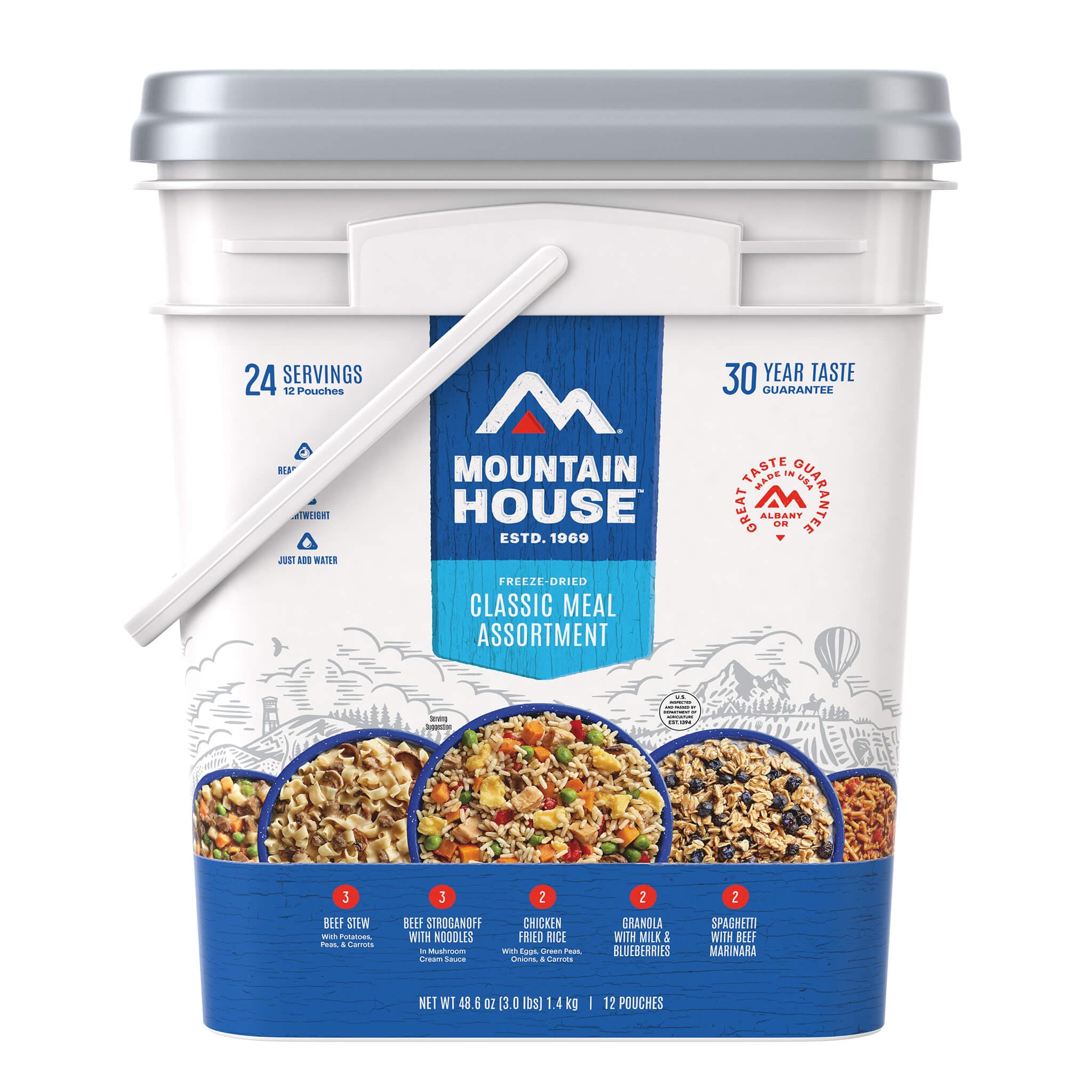
Mountain House Classic Bucket
Check price
- Servings
- 30+
- Shelf Life
- 30 years
- Meals Included
- Full entrees
- Best For
- Taste-focused buyers; upgrade pick
ReadyWise 240 Serving Kit
Pros
- 240 servings provide roughly two months of supplemental meal coverage for one adult
- Up to 25-year shelf life reduces rotation burden significantly
- Covers all meal categories: breakfast, lunch, dinner, and drinks
- Strong value-per-serving ratio among major emergency food brands
Cons
- Some reviewers note sodium content is high across the product line
- Portion sizes run smaller than typical home-cooked meals; active adults may want extra servings
Mountain House Classic Bucket
Pros
- Industry-leading 30-year shelf life guarantee
- Widely considered the best-tasting freeze-dried emergency food on the market
- Convenient resealable bucket packaging; no need to transfer contents
Cons
- Higher price-per-serving than ReadyWise or Augason Farms
- Fewer total servings per package; best used as a high-quality supplement
Storage and Rotation Best Practices
Buying food is only half the equation. Proper storage ensures your supply is edible and safe when you actually need it.
Store food in a cool (50–70°F), dark, and dry location. Temperature fluctuations are the single biggest threat to shelf life — a garage in a hot climate can cut the useful life of stored food in half. A basement, interior closet, or dedicated storage room is ideal.
Use the FIFO method — first in, first out. Rotate older cans and packages to the front of your shelves and place new purchases at the back.
For bulk dry goods like rice, wheat, and beans, store in airtight food-grade plastic buckets (2–6 gallon) with oxygen absorbers and gamma-seal lids. Adding mylar bags inside the buckets provides an extra barrier against moisture and insects.
Frequently Asked Questions
How much water should I store alongside my food supply?
FEMA recommends one gallon of water per person per day for drinking and basic sanitation. For a 30-day supply, that's 30 gallons per person — a significant volume. Supplement stored water with a reliable water filtration system to handle longer-term situations.
Is it safe to eat freeze-dried food past its stated shelf life?
Shelf life dates on emergency food reflect peak quality, not a strict safety cutoff. In most cases, properly stored freeze-dried food remains safe to eat beyond the stated date, though flavor and texture may decline over time.
Can I build a food storage supply on a tight budget?
Yes — the most sustainable approach is gradual accumulation rather than one large purchase. Adding 10–20% extra to each regular grocery trip and setting aside shelf-stable items over two to three months is a low-friction path to a 30-day supply.
How do I prevent pests from damaging my food storage?
Hard food-grade plastic buckets with gamma-seal lids are the most effective barrier against rodents and insects. Store mylar-sealed goods inside buckets, and inspect your storage area every few months for signs of pest activity.
What should I do first if I'm just starting out?
Focus on the foods your family already eats. Start with one extra week of your regular pantry staples, then expand methodically. The goal is a functional, rotating supply — not a single emergency-only stockpile you set aside and forget.
Frequently Asked Questions
Bottom Line
Building an emergency food storage supply is one of the highest-return preparedness investments you can make for your household. With grocery prices projected to increase 3% in 2026 and ongoing supply chain disruptions continuing to affect retail availability, the case for getting started is straightforwardly practical.
Start with the 30-day tier. The Augason Farms 30-Day Pail is the best entry point for budget-conscious families, while the ReadyWise 120 and 240 Serving Kits offer the most convenient all-in-one solutions as you build toward 90 days and beyond.
emergency food storage checklistfood storagelong-term food supplyemergency preparedness food30-day food supply90-day food supply365-day food supplyfreeze-dried food2026
Where to Buy
We may earn a commission when you purchase through these links, at no extra cost to you. This supports our independent research.
Related Articles

Emergency Food
Guide
Growing Your Own Emergency Food Garden: A Beginner's Guide
Learn how to grow an emergency food garden as a beginner — best crops, planting calendar, seed saving, and how to store what you grow for year-round food security.
Read more →
Emergency Food
Comparison
Best Freeze-Dried Food for Long-Term Storage (2026 Review)
Our honest comparison of 5 top freeze-dried food kits for 2026 — real calorie counts, price per serving, and who each kit is actually right for.
Read more →
Emergency Food
Guide
How to Build a 3-Month Emergency Food Supply (Step-by-Step)
The Strait of Hormuz disruption and rising food prices make now the time to build your emergency food supply. This step-by-step guide shows you how to do it in 8–12 weeks.
Read more →