Emergency RadiosComparison
Best Emergency Radios for 2026: NOAA, HAM, and Satellite Options
Our 2026 review of the 5 best emergency radios for home and family use — NOAA reception, S.A.M.E. alerts, power sources, and honest pros/cons compared.
By Editorial Team3 min read
Affiliate Disclosure: This article contains affiliate links. We may earn a commission if you purchase through these links, at no extra cost to you. Our editorial recommendations are independent of these partnerships. Learn about our editorial standards.
Key Takeaways
- 1Midland ER310 ($39) remains the best overall emergency radio — S.A.M.E. alerts, 4 power sources, phone charging
- 2Eton FRX5-BT ($69) is best for daily use — Bluetooth speaker that doubles as an emergency radio when needed
- 3HAM radio requires an FCC license but provides communication when all other systems fail — consider getting licensed
- 4Satellite communicators (Garmin inReach, $300+) provide 2-way messaging anywhere on Earth as the ultimate backup
Best Emergency Radios for 2026: NOAA, HAM, and Satellite Options
In 2025 and 2026, CISA documented Volt Typhoon — a sustained intrusion campaign in which Chinese state-linked actors embedded themselves inside more than 20 US utility and communications networks. The practical implication: in a significant emergency, you may not be able to rely on cellular networks or internet service.
A quality battery-powered emergency radio with NOAA Weather Radio reception is one of the most practical, affordable, and underestimated pieces of emergency preparedness equipment you can own. It costs $30–$200, requires no internet connection, and receives government emergency alerts 24 hours a day.
Key Takeaways
- A NOAA Weather Radio is the single most useful communication tool during a power outage or regional emergency.
- The Midland ER310 is our top pick: best combination of features, reliability, and price.
- The Eton FRX5-BT is the upgrade pick for Bluetooth audio + emergency reception.
- The Sangean MMR-88 is best for audio quality and IPX5 water resistance.
- Hand-crank charging is a backup measure, not a primary power source.
- HAM radio requires an FCC license but provides the most robust two-way communication.
Why NOAA Weather Radio Still Matters in 2026
NOAA Weather Radio All Hazards broadcasts on seven dedicated VHF frequencies, 24/7. Cell tower backup batteries typically last 4–8 hours without grid power. NWR transmitters are hardened, redundant, and have long-duration backup power — one of the last broadcast systems to go down.
What to Look for in an Emergency Radio
- NOAA/NWR reception — any emergency radio without this should be disqualified
- S.A.M.E. alert technology — filters alerts to your specific county
- Multiple power sources (AC, USB-C, AA batteries, solar, hand crank)
- AM/FM coverage plus NOAA/WX; shortwave adds international broadcasts
- IPX3+ water resistance for outdoor or garage use
- USB charging port to charge your phone from the radio's battery
Quick Comparison: Best Emergency Radios
Top 5 Emergency Radios (2026)
| Feature | |||||
|---|---|---|---|---|---|
| Price | $59 | $89 | $49 | $34 | $79 |
| NOAA/S.A.M.E. | Yes/Yes | Yes/Yes | Yes/Yes | Yes/No | Yes/Yes |
| Power Sources | 5 sources | 5 sources | 5 sources | 4 sources | 4 sources |
| Shortwave | No | No | Yes | No | No |
| Extra Features | USB out, SOS, flashlight | Bluetooth, USB out, flashlight | 5-LED flashlight, reading lamp | USB out, flashlight, SOS | AUX input, IPX5, superior audio |
| Best For | Most families | Bluetooth + emergency | Shortwave + value | Budget pick | Audio quality + durability |
Midland ER310
$59
- NOAA/S.A.M.E.
- Yes/Yes
- Power Sources
- 5 sources
- Shortwave
- No
- Extra Features
- USB out, SOS, flashlight
- Best For
- Most families
Eton FRX5-BT
$89
- NOAA/S.A.M.E.
- Yes/Yes
- Power Sources
- 5 sources
- Shortwave
- No
- Extra Features
- Bluetooth, USB out, flashlight
- Best For
- Bluetooth + emergency
Kaito KA500
$49
- NOAA/S.A.M.E.
- Yes/Yes
- Power Sources
- 5 sources
- Shortwave
- Yes
- Extra Features
- 5-LED flashlight, reading lamp
- Best For
- Shortwave + value
RunningSnail MD-090
$34
- NOAA/S.A.M.E.
- Yes/No
- Power Sources
- 4 sources
- Shortwave
- No
- Extra Features
- USB out, flashlight, SOS
- Best For
- Budget pick
Sangean MMR-88
$79
- NOAA/S.A.M.E.
- Yes/Yes
- Power Sources
- 4 sources
- Shortwave
- No
- Extra Features
- AUX input, IPX5, superior audio
- Best For
- Audio quality + durability
Our Top Pick: Midland ER310
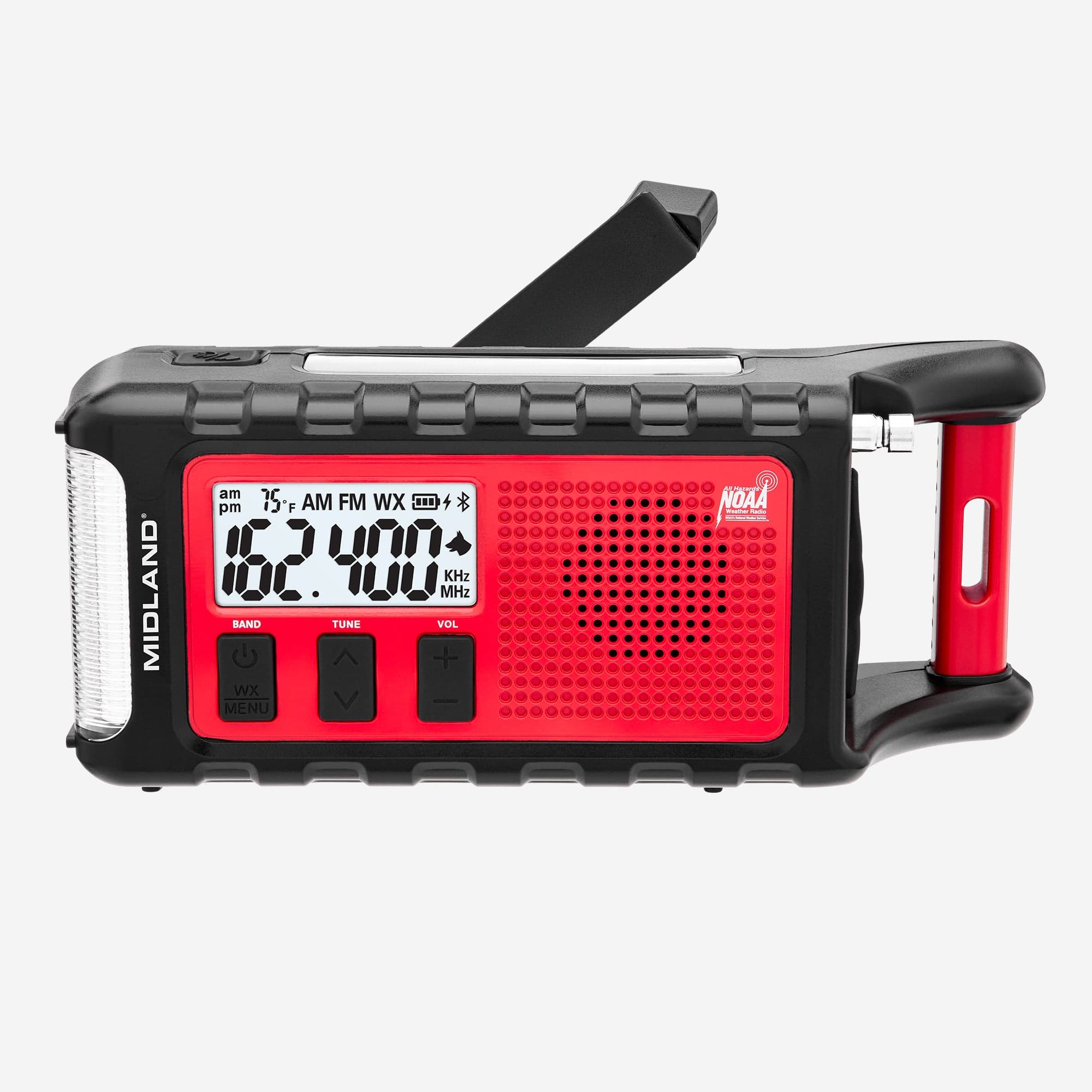
The Midland ER310 is the emergency radio we'd give to most families. It combines five power sources, NOAA/WX with S.A.M.E. county alerts, LED flashlight, USB output, and an emergency SOS siren — all for approximately $59.
Midland has been building radios since 1959. The S.A.M.E. programming is straightforward, the alert tone is loud and distinct, and the radio can wake you if an emergency alert comes through overnight.
Midland ER310 Emergency Radio
Pros
- Five power sources: solar, crank, USB-C, AA batteries, and AC adapter
- S.A.M.E. county-specific alert programming — reduce alert fatigue
- USB output port lets you charge a smartphone from the radio's battery
- Emergency SOS siren for signaling
- Simple, intuitive programming interface
- Strong brand track record — decades of emergency radio manufacturing
Cons
- No Bluetooth — can't stream audio from your phone
- No shortwave reception
- AM/FM audio quality is functional, not impressive
- No external antenna port — weak-signal areas may suffer
Upgrade Pick: Eton FRX5-BT
The Eton FRX5-BT is the emergency radio to choose if you want a device that earns its place in everyday life. Bluetooth capability means you can pair your phone and use it as a speaker — keeping it charged and familiar so it's ready when needed.
Eton FRX5-BT Emergency Radio
Pros
- Bluetooth audio streaming — use as a daily speaker, keeping it charged
- Better AM/FM audio quality than most competitors
- Five power sources: solar, crank, USB, AA batteries, AC adapter
- S.A.M.E. county-specific alerts with audible alarm mode
- USB output for phone charging
Cons
- $30 more than Midland ER310 — justified only if you use Bluetooth
- No shortwave reception
- Bluetooth pairing can occasionally drop
- Slightly larger and heavier than Midland ER310
Best Shortwave: Kaito KA500
The Kaito KA500 covers AM, FM, five shortwave bands, and NOAA/WX. At ~$49, it also includes a five-LED flashlight and a separate reading lamp — practical for extended outages.
Kaito KA500 Emergency Radio
Pros
- Best shortwave coverage: 5 SW bands + AM/FM + NOAA/WX
- Most affordable SAME-capable radio at ~$49
- Five power sources including solar and crank
- Five-LED flashlight plus separate reading lamp
- Compact and lightweight — easy to pack in an evacuation bag
Cons
- Weakest build quality in this comparison
- Modest audio quality; shortwave can be static-heavy
- No Bluetooth or USB output for device charging
- Shortwave usefulness is a niche consideration
Budget Pick: RunningSnail Emergency Radio
At ~$34, the RunningSnail MD-090 is the most affordable entry point that still delivers genuine emergency functionality: NOAA/WX reception, hand crank and solar charging, USB output for phone charging, and an LED flashlight.
RunningSnail Emergency Radio
Pros
- Most affordable option at ~$34
- Includes NOAA/WX reception — core emergency functionality covered
- USB output for device charging
- Multiple power sources: solar, crank, USB in, AA batteries
- Compact and lightweight — fits in a go-bag or car kit
Cons
- No S.A.M.E. county-specific alert filtering
- Budget-tier audio quality on AM/FM
- Least durable build quality in this comparison
- Shorter brand track record than Midland, Eton, or Sangean
Best Build Quality: Sangean MMR-88
The Sangean MMR-88 is the premium build-quality option. Audio fidelity on AM/FM is noticeably better than any other radio here, and the IPX5 water-resistance rating handles direct water spray.
Sangean MMR-88 Emergency Radio
Pros
- Best audio quality — genuinely pleasant for extended listening
- IPX5 water resistance — withstands direct water spray
- S.A.M.E. county-specific alert capability
- Strong build quality from a long-established audio electronics brand
- Compact, well-designed form factor
Cons
- No solar panel charging — unlike Midland, Eton, and Kaito
- Micro-USB charging (not USB-C) — less convenient in 2026
- No Bluetooth or shortwave reception
- No USB output for charging other devices
Beyond NOAA Radios: HAM and Satellite Options
A Note on HAM Radio
HAM (amateur) radio requires an FCC license, but the entry-level Technician license is surprisingly accessible — a 35-question multiple-choice exam with no Morse code requirement. Licensed operators have access to VHF/UHF frequencies used by community emergency networks and local repeater systems. If you're serious about communications preparedness, a Technician license is worth considering.
For most suburban families, a quality NOAA radio is the right starting point. HAM and satellite options are meaningful upgrades for families who want deeper communications resilience.
How to Set Up Your Emergency Radio
- Find your NOAA station frequency at weather.gov/nwr
- Program S.A.M.E. codes using FIPS county codes from weather.gov/nwr/fips
- Test alert reception during weekly NOAA tests (Wednesdays 11 AM–12:45 PM)
- Set alert mode to sound an alarm for overnight emergency alerts
- Keep the battery charged — plug in periodically so it is ready
Frequently Asked Questions
What is NOAA Weather Radio and why does it matter?
NOAA Weather Radio All Hazards is a nationwide network broadcasting weather forecasts, severe weather warnings, and emergency alerts on seven VHF frequencies 24/7. It remains functional when cellular and internet are unavailable.
Do I need a license to use an emergency radio?
No. NOAA Weather Radio is receive-only — no license required. HAM radio, which allows two-way transmission, requires an FCC Technician license (35-question exam).
What is S.A.M.E. technology on emergency radios?
S.A.M.E. (Specific Area Message Encoding) lets you program your radio to only alert for emergencies in specific counties you specify, reducing alert fatigue.
Can I use an emergency radio to charge my phone?
Models with USB output ports — including the Midland ER310, Eton FRX5-BT, and RunningSnail — can charge smartphones from their internal battery. Expect 20–50% of a phone charge from a fully charged radio.
Midland ER310
9.2
out of 10Reception Quality9.0
Battery Life8.5
Durability9.0
Features9.5
Value9.5
Our Verdict
The best emergency radio for most families. S.A.M.E. county-specific alerts and 4 power sources at just $39.
Eton FRX5-BT
8.5
out of 10Reception Quality8.5
Battery Life8.0
Durability8.5
Features9.0
Value7.5
Our Verdict
Best for people who want a daily-use Bluetooth speaker that is always charged and ready for emergencies.
Frequently Asked Questions
Bottom Line
The best emergency radio 2026 for most families is the Midland ER310. It's reliable, affordable at $59, covers all the essential bases, and comes from a brand with a proven track record.
If Bluetooth audio streaming matters, the Eton FRX5-BT justifies its $89 price by being genuinely useful between emergencies. The Sangean MMR-88 earns its place for audio quality and IPX5 water resistance.
Whatever you choose, set it up, program your county's S.A.M.E. codes, and keep it charged. The radio you haven't set up won't help you when you need it.
best emergency radio 2026NOAA emergency radio reviewMidland ER310 reviewEton FRX5-BT reviewcommunications preparedness
Where to Buy
We may earn a commission when you purchase through these links, at no extra cost to you. This supports our independent research.
Related Articles

Emergency Radios
Checklist
Family Emergency Communication Plan: Step-by-Step Template
A step-by-step guide to creating a family emergency communication plan with a printable template, out-of-state contact strategy, meeting points, and emergency radio recommendations.
Read more →
Pillar
Best Emergency Radio for 2026
The top 5 emergency radios compared: Midland ER310, Kaito KA500, Eton FRX5-BT, RunningSnail, and Sangean MMR-88. Find the best NOAA weather radio for your emergency kit.
Read more →