Solar GeneratorsPillar
Emergency Power Backup: What to Do When the Grid Is Under Pressure
Grid stress is real in 2026. Here's how to choose and set up the right emergency power backup for your home — from portable stations to whole-home systems.
By Editorial Team5 min read
Affiliate Disclosure: This article contains affiliate links. We may earn a commission if you purchase through these links, at no extra cost to you. Our editorial recommendations are independent of these partnerships. Learn about our editorial standards.
Key Takeaways
- 1EcoFlow Delta Pro Ultra is top pick for serious home backup — expandable to 90kWh with 7,200W output
- 2Anker SOLIX F2000 offers the best value at ~$1,699 with strong capacity and UPS mode
- 3Start with 2,000-3,000Wh LFP solar generator paired with 400-800W of solar panels for most homes
- 4Volt Typhoon cyberattacks confirm grid vulnerabilities — backup power is no longer optional for families
Two converging threats are putting the US power grid under more stress than at any point in recent memory. First, geopolitical instability following Operation Epic Fury — the February 28 US-Israel strikes on Iranian nuclear facilities — has pushed oil prices 13% higher. Second, the Volt Typhoon campaign revealed that Chinese state-linked hackers had embedded themselves in over 20 US utility networks for periods exceeding 300 days, according to a joint FBI/NSA advisory.
These aren't abstract threats. They're the backdrop against which every American family now needs to think seriously about home backup power. The good news is that reliable emergency power backup has never been more accessible or more affordable relative to the risks it mitigates.
Key Takeaways
- The US grid faces simultaneous pressure from geopolitical energy shocks and confirmed cyberattack infiltration (Volt Typhoon, 20+ utilities).
- Three tiers: portable power stations (easiest), whole-home solar + battery (most capable), and gas generators (cheapest upfront, highest ongoing cost).
- A 2,000Wh station handles most essentials; 5,000Wh+ covers an extended, more comfortable outage.
- Top picks: EcoFlow Delta Pro Ultra (best overall), Bluetti AC300 + B300 (most modular), Jackery Explorer 2000 Plus (best portable), Anker SOLIX F2000 (best value).
Why the Grid Is Under More Pressure in 2026
The North American Electric Reliability Corporation (NERC) has flagged increasing reliability risk, driven by aging transmission infrastructure, rising electricity demand from data centers and EV charging, and rapid integration of intermittent renewables. The 2025 European blackout — when Spain lost 60% of its generation capacity in under 5 seconds, causing a 24-hour outage across Spain, Portugal, and parts of France — was a sharp reminder that modern grids can fail quickly and recover slowly.
Volt Typhoon: A Specific Domestic Threat
The Volt Typhoon revelations describe a Chinese state-linked hacking campaign that successfully embedded persistent access tools in critical US infrastructure networks — including electric utilities, water systems, and communications providers. The FBI/NSA joint advisory noted that attackers maintained access for periods exceeding 300 days, and that an estimated 60 new grid vulnerabilities are discovered daily.
Average Outage Duration Is Rising
According to DOE and EIA data, the average US power outage duration has increased to approximately 12.8 hours as of 2025. Winter Storm Fern (January 23–27, 2026) left 750,000 customers without power, some for over a week.
Oil Prices and Energy Costs
The Strait of Hormuz disruption pushed Brent crude to $82/barrel, with projections to $100/barrel in a sustained-closure scenario. Higher oil prices translate directly to higher electricity costs in regions that rely on natural gas. Solar-charged power stations are gaining ground: their operating cost is effectively zero once purchased, regardless of what happens to fuel prices.
How to Size Your Emergency Power Backup
Before looking at specific products, you need to understand what you're actually trying to power. Most families don't need to run the whole house — they need to keep the most critical items running.
Identify Your Critical Loads
- Refrigerator/freezer: 100–400 watts, cycles on ~50% of the time. Estimate 150–200Wh per hour.
- Medical devices: CPAP 30–60W, oxygen concentrators 150–600W. Always verify specs.
- Lighting: 10 LED bulbs at 10W each = 100W total.
- Phone and device charging: 10–20Wh per device per full charge.
- Internet router + modem: 10–30W combined.
- Window AC (summer): A 5,000 BTU unit draws around 500W.
A family running a refrigerator, lights, phone charging, and a CPAP for 24 hours needs roughly 3,000–4,000Wh of usable capacity per day. That's your baseline for sizing.
Don't Undersize for Medical Needs
If anyone in your household depends on a powered medical device — CPAP, oxygen concentrator, electric wheelchair — treat their power needs as non-negotiable and size up from there. An oxygen concentrator drawing 400W for 8 hours per night needs 3,200Wh just for that single device.
The Best Emergency Power Backup Options for 2026
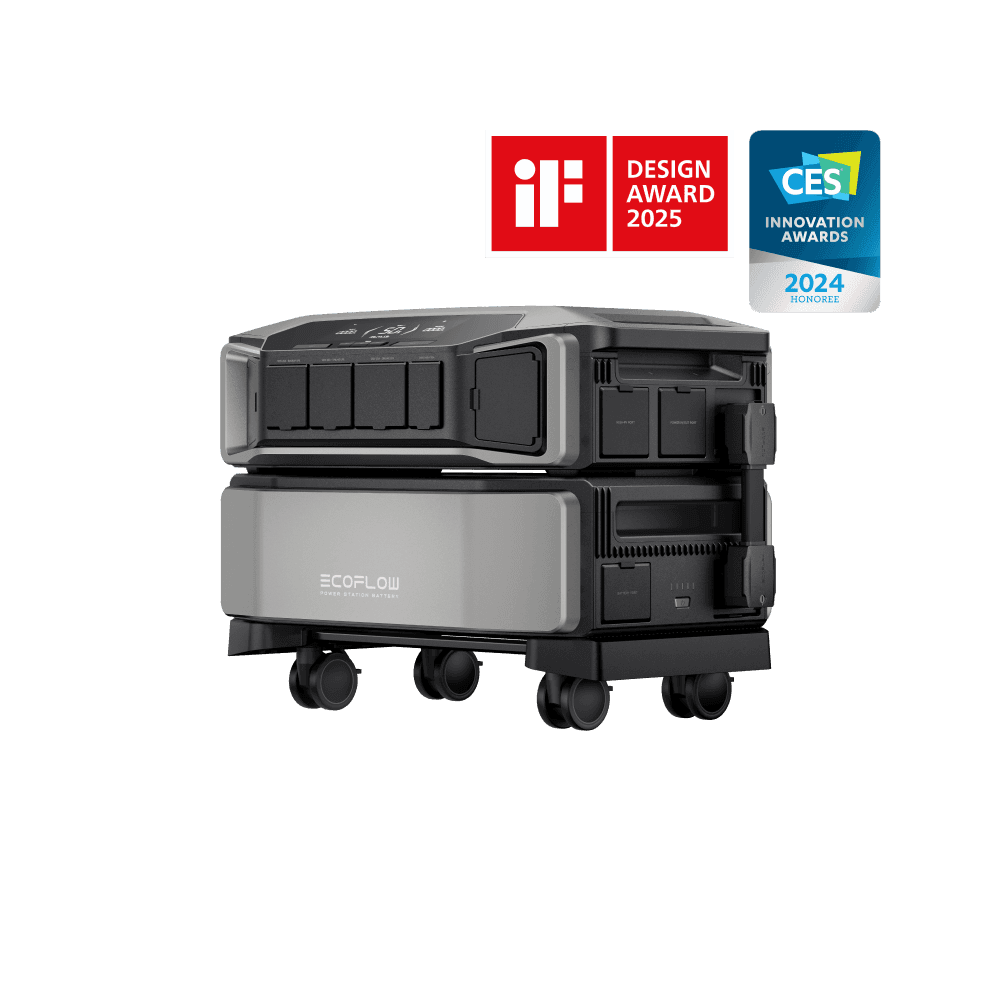
Best Overall: EcoFlow Delta Pro Ultra
The EcoFlow Delta Pro Ultra is the most capable single-unit home backup power station currently available. It ships with 6,144Wh of capacity and supports expansion to 21.4kWh. It handles up to 7,200W of AC output, which means it can run high-draw appliances including central HVAC with a soft-start adapter.
EcoFlow's LFP battery chemistry is rated for 3,500+ charge cycles before dropping to 80% capacity — roughly 10 years of daily use. It also supports smart home integration and has a dedicated transfer switch kit.
EcoFlow Delta Pro Ultra
Pros
- 6,144Wh base capacity, expandable to 21.4kWh — handles extended multi-day outages
- 7,200W AC output supports HVAC with soft-start, electric dryer, and other high-draw appliances
- LFP battery rated 3,500+ cycles for long service life
- Supports solar input up to 2,800W for fast solar recharge
Cons
- Premium price point — significant upfront investment
- Heavy at 132 lbs — best as a semi-permanent home installation
- Complex ecosystem can have a learning curve for first-time users
Best Modular System: Bluetti AC300 + B300
The Bluetti AC300 + B300 system lets you start at one capacity and expand as budget allows. The AC300 is the inverter unit, and each B300 module adds 3,072Wh. Connect one to start at 3,072Wh; connect up to four for 12,288Wh.
Bluetti AC300 + B300
Pros
- Fully modular: start at 3,072Wh, expand to 12,288Wh with additional batteries
- LFP battery chemistry rated 3,500+ cycles
- 3,000W AC output handles most household appliances including window AC
- Supports both solar and grid charging simultaneously
Cons
- AC300 has no built-in battery — needs at least one B300 to function
- 3,000W output is lower than EcoFlow Delta Pro Ultra for high-draw applications
- B300 batteries add weight and cost quickly when scaling up
Best Portable Option: Jackery Explorer 2000 Plus
The Jackery Explorer 2000 Plus hits a practical sweet spot — 2,042Wh base capacity (expandable to 12,000Wh), 3,000W AC output, and genuinely portable at 61 lbs.
Jackery Explorer 2000 Plus
Pros
- 2,042Wh base with expandable battery packs up to 12,000Wh
- Genuinely portable at 61 lbs — usable for camping and outdoor as well
- 3,000W AC output handles most standard household appliances
- Strong brand reputation and warranty support
Cons
- Base unit runs out faster during multi-day outage without solar recharge
- Battery pack expansion is less elegant than Bluetti's B300 system
Best Value at This Tier: Anker SOLIX F2000
The Anker SOLIX F2000 delivers 2,048Wh with 2,400W AC output at a price point typically 15–25% lower than equivalent EcoFlow and Bluetti options. LFP battery rated for 3,000+ cycles.
Anker SOLIX F2000
Pros
- Competitive price per watt-hour relative to EcoFlow and Bluetti equivalents
- LFP battery chemistry rated 3,000+ cycles
- Anker's established electronics reputation — strong warranty and support
- Compact design relative to capacity
Cons
- 2,048Wh with no modular expansion path (unlike Jackery or Bluetti)
- 2,400W AC output is lower than top competitors at this tier
- Fewer solar panels in Anker's lineup compared to EcoFlow or Jackery
Comparison at a Glance
Emergency Power Backup — Top Picks 2026
| Feature | |||||
|---|---|---|---|---|---|
| Price | Check | Check | Check | Check | Check |
| Capacity | 6,144Wh (exp. 21.4kWh) | 3,072Wh (exp. 12.3kWh) | 2,042Wh (exp. 12kWh) | 2,048Wh | 983Wh |
| AC Output | 7,200W | 3,000W | 3,000W | 2,400W | 2,000W |
| Battery | LFP, 3,500+ cycles | LFP, 3,500+ cycles | LFP | LFP, 3,000+ cycles | NMC |
| Best For | Whole-home extended backup | Modular, scalable setup | Portability + expandability | Best price-per-watt | Lighter loads, starter option |
EcoFlow Delta Pro Ultra
Check
- Capacity
- 6,144Wh (exp. 21.4kWh)
- AC Output
- 7,200W
- Battery
- LFP, 3,500+ cycles
- Best For
- Whole-home extended backup
Bluetti AC300 + B300
Check
- Capacity
- 3,072Wh (exp. 12.3kWh)
- AC Output
- 3,000W
- Battery
- LFP, 3,500+ cycles
- Best For
- Modular, scalable setup
Jackery Explorer 2000 Plus
Check
- Capacity
- 2,042Wh (exp. 12kWh)
- AC Output
- 3,000W
- Battery
- LFP
- Best For
- Portability + expandability
Anker SOLIX F2000
Check
- Capacity
- 2,048Wh
- AC Output
- 2,400W
- Battery
- LFP, 3,000+ cycles
- Best For
- Best price-per-watt
Goal Zero Yeti 1000X
Check
- Capacity
- 983Wh
- AC Output
- 2,000W
- Battery
- NMC
- Best For
- Lighter loads, starter option
Pairing Your Power Station with Solar Panels
A power station without a solar recharge path is a finite resource. A power station with solar panels is a renewable one — which matters enormously during a multi-day outage. For most households, two 200W–400W panels placed in full sun provide enough daily recharge to cover essential loads indefinitely.
Setting Up Your Emergency Power Backup Safely
- Keep it accessible. A power station stored behind boxes isn't useful during an emergency. Keep it in a garage or utility room — fully charged — with cables nearby.
- Charge it regularly. LFP batteries perform best at 20–80% charge for long-term storage.
- Know what you're going to power before the outage. Label the cables and tape a short list to the unit.
- Never run a gas generator indoors. CO poisoning is the leading cause of generator-related deaths.
Never Run a Gas Generator Indoors or in an Attached Garage
Carbon monoxide poisoning kills approximately 400 Americans per year during power outages, almost all from gas generator misuse. A portable solar power station produces zero emissions and is safe for indoor use. If you do use a gas generator, it must be operated outdoors, at least 20 feet from any door, window, or vent.
Frequently Asked Questions
How long will a 2,000Wh power station last during an outage?
Running a modern refrigerator (~150Wh/hr), LED lighting (50W), and phone charging (30Wh/night), you'd use roughly 200–250Wh per hour in active use. A 2,048Wh unit provides approximately 8–12 hours of this mixed load. With solar recharge, that cycle repeats daily indefinitely.
What's the difference between LFP and NMC batteries?
LFP (lithium iron phosphate) batteries are safer, last longer (2,000–3,500+ cycles vs. 500–1,000 for NMC), and perform better in temperature extremes. NMC (nickel manganese cobalt) batteries offer higher energy density for smaller/lighter units. For home backup where weight isn't a priority, LFP is the better long-term choice.
Can I run my whole house on a portable power station?
Not typically. The exception is the EcoFlow Delta Pro Ultra with its 7,200W output, which can handle central HVAC with a soft-start adapter. For most households, the practical goal is powering critical loads (refrigerator, medical devices, lighting, communication) rather than the full home.
How does grid cyberattack risk actually affect my household?
The Volt Typhoon campaign involved attackers gaining persistent access to utility SCADA (control) systems. If attackers chose to trigger outages, they could potentially do so in targeted ways that normal utility crews would struggle to fix quickly. This motivates having backup power independent of the grid for at least several days.
Should I get a solar generator or a gas generator?
For short outages (under 48 hours), gas is cheaper upfront. For longer outages, the math shifts: a gas generator burns 0.5–1 gallon/hour ($42–$84/day at $3.50/gallon). A solar station's operating cost is $0. A solar system typically reaches cost parity with gas within 3–5 years.
What's the minimum I should spend for useful home backup?
A useful setup handling refrigerator, lighting, and phone charging for 12–24 hours starts around $800–$1,200 for a quality 1,000–2,000Wh LFP unit. Adding solar panels brings the total to $1,200–$2,000 and makes the system self-sustaining.
Frequently Asked Questions
Bottom Line
Grid reliability in 2026 is under real and documented pressure — from geopolitical energy shocks, rising demand, aging infrastructure, and confirmed cyberattack infiltration. For most suburban households, we recommend starting with a 2,000–3,000Wh LFP solar generator paired with 400–800W of solar panels.
The EcoFlow Delta Pro Ultra is our top pick for households that want serious capacity and expandability. The Anker SOLIX F2000 is the right call if you want strong capability at a more accessible price point.
Where to Buy
We may earn a commission when you purchase through these links, at no extra cost to you. This supports our independent research.
Related Articles
Solar Generators
Comparison
Best Solar Generators for Home Backup Power: 2026 Update
We compared the top solar generators for home backup in 2026 — capacity, output, expandability, and value. Picks from EcoFlow, Bluetti, Anker, and Jackery.
Read more →
Solar Generators
Comparison
Solar Generator vs Gas Generator: Which Is Better for Hurricane Season 2026?
Compare solar generators and gas generators for hurricane season 2026 — upfront costs, runtime, safety, and total cost of ownership with our top three solar picks.
Read more →
Solar Generators
Comparison
Best Home Battery Backup Systems: Solar + Storage for Grid Independence (2026)
The top solar + battery backup systems for 2026 compared: capacity, solar input, cost, and IRA tax credit eligibility.
Read more →

Emergency Food
Guide
Growing Your Own Emergency Food Garden: A Beginner's Guide
Learn how to grow an emergency food garden as a beginner — best crops, planting calendar, seed saving, and how to store what you grow for year-round food security.
Read more →